CASE STUDY - MICROLEARNING & EDTECH

Creator-led microlearning platform. Live on web, Android, and iOS in 6 weeks.

How Knovo built a scalable short-form video learning product - with smart preloading, recommendation-grade analytics, and zero video infrastructure overhead

6 Weeks
From first integration to full product launch
4.9★
Rating across Android and iOS app stores
4+
Developer team that shipped it end-to-end
1

At a glance​

Company
Knovo

www.knovo.in

Android App

iOS App

Industry
Microlearning & EdTech
USE CASE
Creator-led short-form video learning platform

Key Products used
On-Demand Video APIs Video Player SDK (Web, Android, iOS) Video Data & Analytics Playlist API Resumable Upload SDK
At a glance​

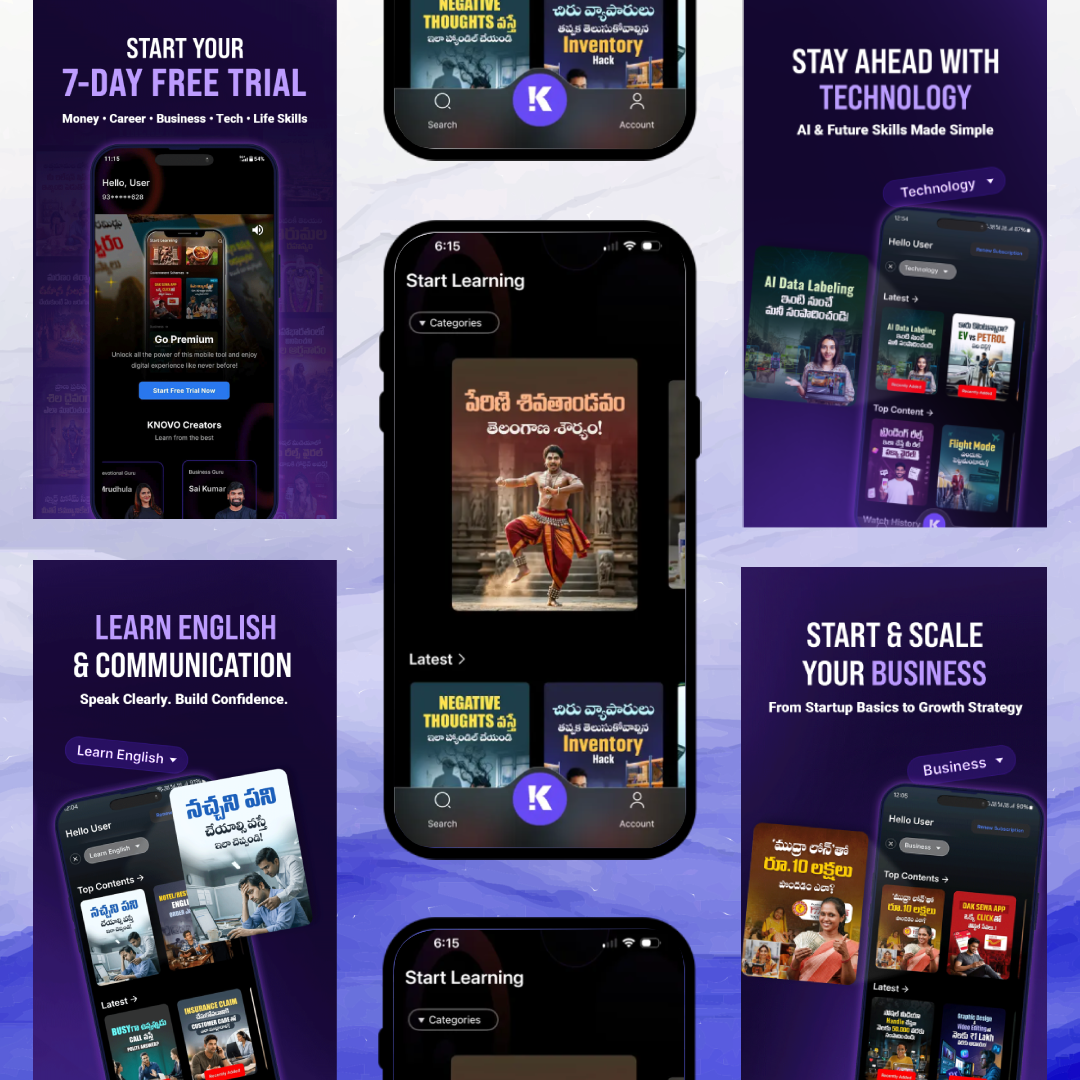
Knovo is a mobile-first microlearning platform that connects expert creators with learners through short-form video lessons. Built by a digital media company with over 6 million app downloads and 7.5 million YouTube subscribers. Knovo applies the same editorial instincts that built a mass news audience to structured, creator-led education.

The platform delivers bite-sized lessons across categories including personal finance, career development, entrepreneurship, communication skills, technology and AI, health and wellness, and more. Content follows the microlearning principle that learners retain more from focused sessions of 3-10 minutes than from longer-form courses, and that the first few seconds of a video determine whether a learner continues or scrolls away.

Knovo’s model is creator-first: the platform is built around attracting expert educators, measuring their content’s performance, and paying creator dues based on verified engagement data. This makes the analytics layer not just a product feature but a commercial necessity; watch time, completion rate, and seek behaviour are the inputs that determine how creators get paid.

Video is the entire product. Playback quality, load speed, content security, and recommendation accuracy are not supporting features, they are the product. Every infrastructure decision flows from that reality.

1
2

Building a fast-scrolling video learning product is a different engineering problem

​“Our focus was launching a product that brought together expert creators and educational content in a microlearning format that appeals to our young audience. As a video-centric product, we thought a great deal about the experience, content security, speed of loading for fast scrolling, analytics to power recommendation algorithms and for calculating creator dues, playlists, and so on. And all this in a way that can deliver a custom experience that will evolve. So it’s not just today but also tomorrow.”
— Prabhakar P, Head of Digital, Knovo
Short-form learning video places demands on infrastructure that are fundamentally different from standard video-on-demand. In a microlearning product, users scroll fast. They decide whether to engage within the first three to seven seconds. If a video takes two seconds to begin playing, the learner has already moved on. Speed of startup is not a nice-to-have, it is the product experience.

At the same time, content must be reliably secure. In a creator economy model where educators build their livelihoods on the platform, content protection is a commercial obligation. Lessons cannot be easily downloaded or redistributed outside the platform.

The Knovo team also needed a recommendation engine from day one. In a catalogue of bite-sized lessons, the algorithm that surfaces the next relevant video is what keeps learners in a session. That algorithm runs on engagement data, which means the analytics platform cannot be an afterthought bolted on later. It has to be instrumented from the first video play.
Their full requirements list was demanding:
  • Sub-second playback startup across mobile networks for a fast-scrolling UX

  • Smart preloading and caching to eliminate buffering between consecutive lessons in a playlist
  • Granular per-session analytics: watch time, completion rate, seek behaviour, and drop-off curves. The inputs for both recommendation engines and creator payment calculation
  • Content security to protect creator IP
  • A fully branded, programmable player for web, Android, and iOS, not a generic embed
  • Playlist API support so learners flow seamlessly through curated learning sequences
  • Resumable uploads to support a high-volume content pipeline as more creators joined the platform
  • Pay-as-you-go pricing with no long-term minimums, a creator platform scales unpredictably at launch
The team initially evaluated off-the-shelf learning platforms. They ruled them out quickly: none offered the flexibility needed to build a fully custom product experience, and the engineering team, self-described as engineering-first, wanted control over every layer of the user experience, from player behaviour to recommendation logic.

That left a choice between assembling a custom stack, separate vendors for encoding, CDN, player SDKs, and analytics, or finding a video infrastructure platform that consolidated enough of those components to reduce integration surface while still giving full programmatic control.
​“We initially considered some custom off-the-shelf platforms, but quickly realised they didn’t offer us the flexibility we needed. We are an engineering-first organisation and given our expertise, we realised we could easily build this in a way that offered full control over experience, experimentation, and speed.”
— Prabhakar P, Head of Digital, Knovo
3

From first API call to a fully live microlearning platform

“We considered our options and decided on FastPix because: very fast uploads and delivery; having more of the infrastructure and features we needed, including the in-built deep analytics and web and mobile player, in one place, as opposed to say AWS or Kaltura, reduced the complexity for us. Pay as you go: there was no lock-in to long-term contracts, and we could only pay as we grew. No fixed minimums. And support: there were a few pieces we needed help with and they seemed most approachable.”
— Prabhakar P, Head of Digital, Knovo
The Knovo team evaluated FastPix against other providers and made their decision on four criteria: upload and delivery speed, breadth of the product suite, commercial model, and support quality.
The integration covered the full video stack: FastPix On-Demand Video APIs for the upload and encoding pipeline, the FastPix Player SDK deployed across web, Android, and iOS, the Playlist API for sequenced lesson delivery, and FastPix Video Data for per-session analytics. Rather than stitching together separate services, the Knovo team had a single API surface with consistent data models across every component.​
One of the more technically demanding requirements was the fast-scroll playback experience. In a microlearning feed, learners expect the next video to be instantly ready, the same expectation set by short-form social video. The team built smart caching and preloading logic on top of the FastPix Player SDK and Playlist API working in combination. Server-side delivery optimisations that would have required significant custom work were already built into the FastPix infrastructure.
“Working with FastPix was easy for our 4+ team of developers, they were always available to jump on brainstorming sessions at short notice. This became important as we built smart caching and preloading to support the speed users expect in fast scrolling. In our scenario, delivery has to be super-fast. And you need support from the server side to do this. Much of this came in-built with FastPix Player and it worked in sync with their Playlist API and delivery platform, which reduced our effort.”
— Prabhakar P, Head of Digital, Knovo
FastPix Video Data became one of the most strategically important components of the platform, not just for product analytics but for the creator economy model at Knovo’s core. Creator dues are calculated from verified watch data. Recommendation algorithms are trained on completion and engagement signals. The team needed events that were accurate, granular, and available out of the box.

What the data also unlocked was a framework for evaluating content quality itself. Microlearning content follows what the Knovo team calls the 3-7-21 formula, a structure for how educational information should be layered and paced across a short video. Video Data gave both the platform team and individual creators the ability to test whether that structure was actually working: were learners dropping off in the first three to seven seconds? Were they completing at least 50% of a lesson before moving to the next? Were they seeking back to replay a specific segment?
“The in-built analytics platform was also super helpful, it helped power our recommendation engines. They captured all the events out of the box and we were just able to use them. A different way we used it was analysing watch times, completion times, and seek times to check content effectiveness. Most microlearning content follows a 3-7-21 formula, so is the way the content is structured effective? Are there drop-offs in the first 3-7 seconds? That tells us and our creators a lot, and we have gotten better in how we all can structure the video content for maximum engagement. Ultimately it only helps if folks consume at least 50% of content, and then move to other videos in the playlist.”
— Prabhakar P, Head of Digital, Knovo
The platform went live in six weeks. Within weeks of launch, Knovo had accumulated thousands of sign-ups, paying subscribers, and a 4.9-star rating across app stores. The feedback from early users focused on three things: quality, speed, and ease of use, the exact outcomes the infrastructure choices were designed to deliver.
“The feedback has been incredible, within weeks, we’ve racked up thousands of sign-ups, paying users, and a 4.9 rating across app stores. People rave about the quality, speed, and ease of use in our video app. Since our model centres on content and video creation, skipping the hassle of distribution has been a game-changer for us, it just eliminates that headache entirely. For the team, it means we’re 100% sure we’re delivering top-tier learning for students and tutors.”
— Pavan K, Digital Marketing and Customer Success Manager, Knovo
For the Knovo engineering team, the outcome of the FastPix integration was not just a faster launch, it was a different kind of team focus. Instead of maintaining video encoding pipelines or debugging CDN routing, the four-person team could focus on the recommendation logic, the creator dashboard, and the product features that differentiate Knovo in the microlearning market.

The roadmap ahead includes live sessions with expert educators, expanded content categories, and deeper personalisation of the learning feed. FastPix’s live streaming infrastructure is already available to the team when those features are ready, without a new vendor relationship or a separate integration project.